I don’t know what we had been shouting as we flung ourselves in opposition to the gates of Buckingham Palace on 20 November 1947 – one thing ecstatic like maenads within the wake of Bacchus, actually nothing vital. This was an indication of pleasure. My fellow maenad was my greatest good friend from St Mary’s Convent in Ascot, Lucy, and we had been 15, up from college. I wish to assume we had been carrying our New Look coats, mine an impractical pale turquoise, hers spinach inexperienced, sweeping to the ground and double-breasted to make us seem to be a few Napoleons, if moderately taller. Nevertheless these coats had been so completely treasured, and none of our skirts had been remotely the identical size, so I moderately assume we had been carrying our navy-blue college macs so as to be prepared for the fray.
Our faces had been actually harmless of any make-up, as my first passport photograph, taken about the identical time, clearly reveals; my essential discovery of a lipstick in Woolworths known as Pink Plum Stunning didn’t happen till I used to be 16, and I had solely as soon as been inside a hairdresser’s – to look at my Nannie have her annual perm. Now, for a short second, we maenads did handle to interrupt via the police cordon and get into the paradise which was the forecourt. (I’ve since checked this reminiscence in opposition to press reviews and it’s true: the police cordon did briefly give manner.)
The deep pleasure of the entire expertise taught me one thing about mob rule: it may be a substantial amount of enjoyable for those who’re a part of the mob, though most likely much less amusing for those who’re within the Tuileries like Marie Antoinette. There’s a kind of zest about it. However then, as I bear in mind it, the entire fantastic event of the royal marriage ceremony, two years after the tip of World Battle II, had an aura of fashionable enthusiasm surrounding it. It was Austerity Britain alright, garments rationed and a stingy provide of coupons (absolutely these enormous coats should have eaten up our complete allowances) in order that I truly made a whole lot of my very own garments out of weird supplies that weren’t restricted, like parachute silk; the horror of machining that slippery eel-like materials stays with me. All the things you needed was rationed, however you realized to not complain. If you happen to did, somebody would say reproachfully: “Consider the ravenous youngsters of Europe.” Then the shameful criticism died away in your lips.
,
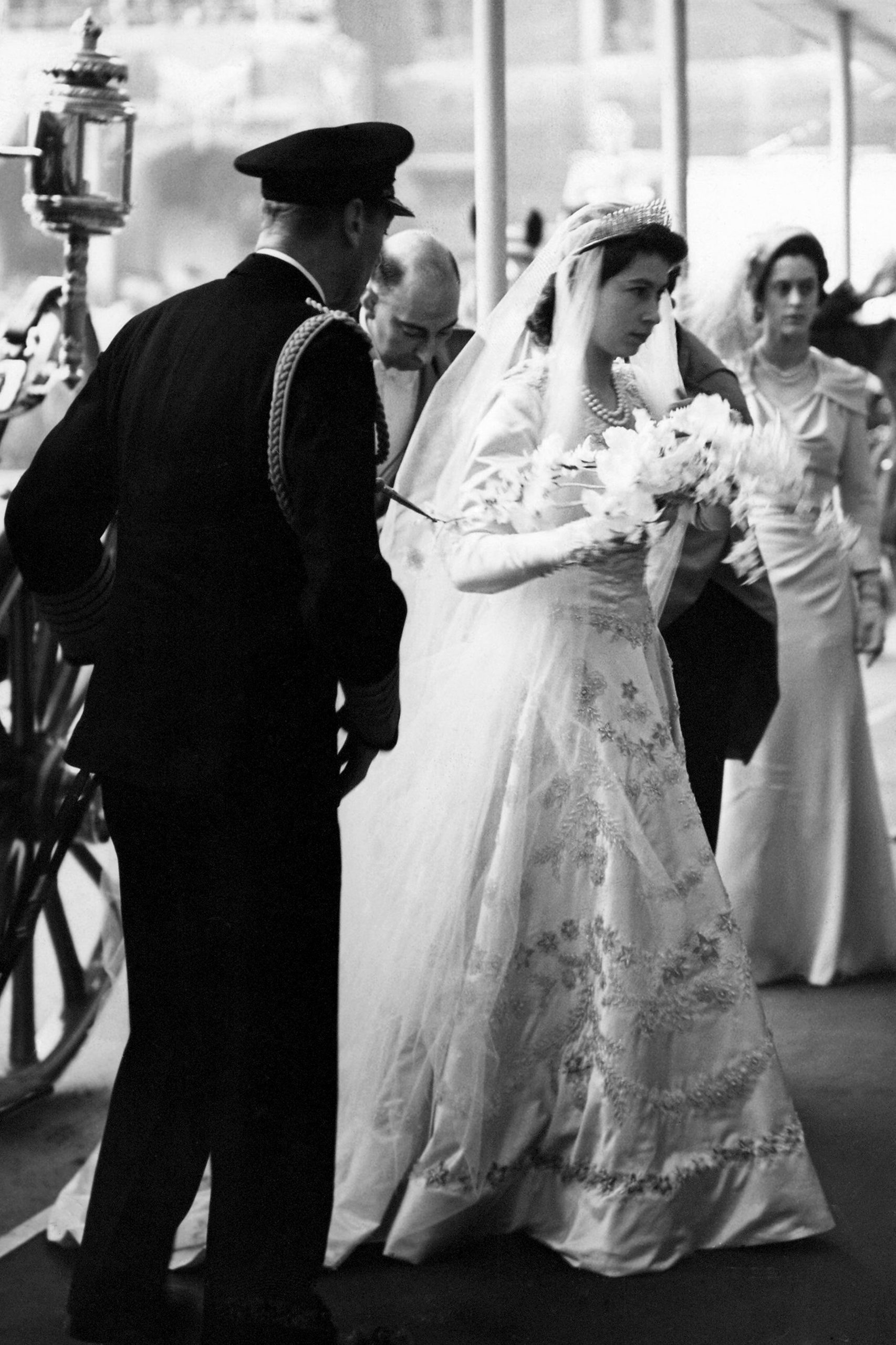
“For the royal couple, Vogue chooses a shoe – an emblem of fine luck – on this case HRH Princess Elizabeth’s personal marriage ceremony shoe. We hope that their lives might be as clean as its satin – their spirit as brilliant as its buckle – and their happiness as excellent as its form,” wrote British Vogue in its December 1947 situation.
And now into this extreme, dutiful world got here a real-life fairy story. The bride was a Princess however she had dressed up as a soldier within the struggle, an bizarre ATS uniform being the fashionable equal of a goose woman’s get-up. The bridegroom, tall, truthful and good-looking, was a sailor and a commoner, however he, too, was a Prince in disguise, of royal inventory. The truth is, on the marriage programme, Prince Philip was nonetheless listed as Lieutenant Philip Mountbatten RN, being created Duke of Edinburgh the very morning of the marriage, too late for the rewrite. It’s true that I couldn’t fairly see Philip Mountbatten because the Marquis of Vidal, aka Satan’s Cub, in Georgette Heyer’s nice romance – to which I used to be a lot addicted (like most women I knew, I used to be looking out for my very own hot-blooded marquis who can be tamed by my cool mind and pure seems to be, as within the guide). However I believed passionately that he was Greek, just like the statues because it had been, and I can’t recall studying something disgruntled about his German blood, nor the truth that his three German sisters weren’t invited to attend Westminster Abbey.
,